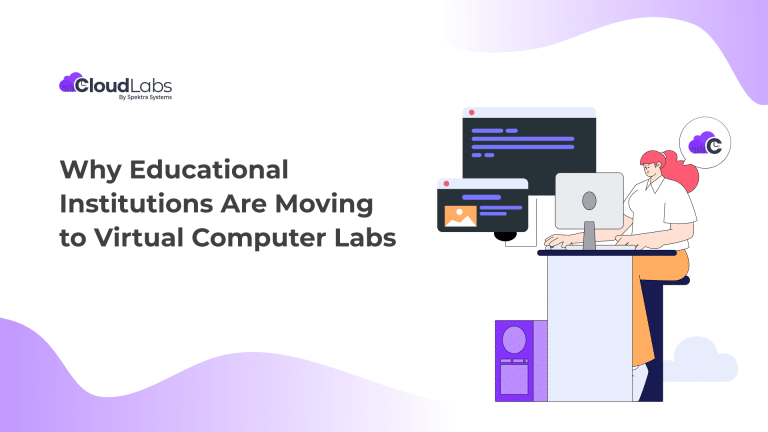
Why Educational Institutions Are Moving to Virtual Computer Labs

Ready to See CloudLabs in Action?
Turn your ideas into hands-on experiences. Tell us what you're looking for, and team CloudLabs will help you find the right solution.
Higher education and technical training are undergoing a structural shift. Learning has expanded beyond classrooms, fixed schedules, or campus boundaries. Students expect access to cloud-based hands-on computing environments that support modern curricula, regardless of location or device.
This shift has placed increasing pressure on traditional IT infrastructure. Physical labs struggle to scale with enrollment growth, remote learning models, and rapidly changing course requirements. As a result, leading institutions are rethinking ways to deliver course programs, enabling instructors with fully managed, consistent, growth-forward, and ready-to-scale virtual computer labs.
Understanding Virtual Computer Labs in Modern Education
At their core, virtual computer labs provide students with fully managed desktop environments available over the cloud of their choice: Azure, AWS, or GCP. These labs replicate the on-campus experience while eliminating the need for physical hardware.
Unlike legacy setups, these environments support multiple operating systems. Institutions can deploy Windows, Linux, or mac OS configurations based on course needs. Access is browser-based, allowing students to log in instantly without installing software or configuring devices.
For IT teams, centralized provisioning replaces manual setup. Labs can be created, updated, monitored, and retired from a single platform, dramatically reducing operational overhead while improving consistency across cohorts.
Why Physical Computer Labs Are No Longer Enough
Traditional labs were designed for a different era of education. Today, they present more limitations than advantages.
Availability is tied to geography and lab schedules, restricting access for remote and hybrid learners. Maintenance costs continue to rise as hardware ages and software updates become more frequent. Students often encounter inconsistent experiences due to device variations or outdated configurations.
Instructors and lab managers also bear the burden. Manual setup, repeated troubleshooting, and environment resets consume valuable instructional time. Over time, these inefficiencies limit an institution’s ability to scale high-quality technical education.
Physical Lab Vs. Virtual Computer Labs
As academic demands scale and diversify, the operational limitations of physical labs become increasingly visible.
| Dimension | Physical Computer Labs | Virtual Computer Labs |
|---|---|---|
| Infrastructure Model | On-premises hardware with fixed capacity | Centrally managed, cloud-hosted environments |
| Capital Investment | High upfront costs for hardware, networking, and space | Minimal capital expense with usage-aligned spending |
| Operating System Support | Limited by installed machines and imaging cycles | Multi-OS environments provisioned on demand |
| Scalability | Slow and linear, requiring new hardware purchases | Elastic scaling based on enrollment and course demand |
| Maintenance Effort | Frequent manual updates, imaging, and repairs | Automated updates and lifecycle management |
| Student Access | Restricted to lab hours and physical location | Browser-based global access as per one’s own time |
| Consistency of Experience | Varies by device condition and configuration | Standardized environments for all learners |
| Instructor & IT Workload | High reliance on IT for setup and troubleshooting | Reduced support overhead through automation |
| Cost Predictability | Ongoing refresh cycles and unexpected failures | Clear visibility into usage and budget planning |
| Readiness for Remote Learning | Limited or non-existent | Built-in support for hybrid and remote delivery |
Academic Use Cases and Impact of Cloud Computer Labs
Beyond improving learning outcomes, cloud computer labs introduce predictable costs, centralized control, and the ability to scale infrastructure in step with institutional demand, helping create a long-lasting impact.
| Academic Area | Technical Requirements | IT & Infrastructure Impact | Instructor Benefits | Student Benefits | Cost Efficiency |
|---|---|---|---|---|---|
| Programming and Software Development Courses | Consistent OS environments, language runtimes, and development tools | Centralized provisioning removes device-level configuration and reduces support tickets | Faster course setup, fewer environment-related disruptions, consistent grading conditions | Immediate lab access, zero software dependency, premium support | Reduces recurring setup and maintenance costs by eliminating physical lab dependencies |
| Data Science and Analytics Learning | High compute capacity, specialized libraries, and large datasets | On-demand resource provisioning without long-term hardware investment | Ability to update labs as technologies evolve. Real-time overview of students VMs | Access to real-world analytics tools and scalable compute resources | Avoids capital expenditure on high-performance lab infrastructure |
| Cross-Disciplinary Technical Training | Hands-on setup across engineering, analytics, and digital programs | Unified lab platform supports multiple departments from a single control plane | Simplified lab management across diverse courses | Seamless experience with cloud credits and lab progress | Prevents duplication of infrastructure and software licensing costs |
How CloudLabs Enables Scalable Virtual Computer Labs
| Capability Area | What CloudLabs Delivers | Institutional Impact |
|---|---|---|
| Lab Availability | Customize environments per course or choose from 200+ pre-built labs | Faster course rollout and standardized learning environments |
| Student Access | Browser-based lab access with zero software dependency | Immediate learning access from anywhere across browsers |
| Scalability | On-demand lab provisioning with automated lifecycle management | Seamless scaling across enrollments, terms, and campuses |
| Instructor Control | Real-time visibility into student VMs with persistent and non-persistent lab options | Improved learner support and fair, consistent assessments |
| Multi-Cloud Flexibility | Deployment on AWS, Azure, GCP, or institutional cloud subscriptions | Greater control over data, compliance, and vendor choice |
| Cost Management | Pay-as-you-go pricing with detailed usage reports and automation-powered cost optimization tools | Predictable budgets and reduced lab infrastructure spend |
| Security & Support | Industry-compliant security with 24/7 premium support | Continuous, secure learning without added IT burden |
CloudLabs, as a purpose-built platform, helps educational institutions deliver hands-on learning through fully managed virtual computer labs, without the operational burden of physical infrastructure. Here is a list of all the benefits available with CloudLabs:
Curriculum Aligned Labs
CloudLabs enables institutions to design custom lab environments that align directly with course objectives and learning outcomes. They can also choose from an extensive catalog of 200+ pre-built labs.
Browser-Based Access
All CloudLabs environments are accessible directly through a web browser of choice, removing the need for external downloads. Multi-cloud compatibility and support for Windows and Linux OS ensure a seamless learning experience.
Scalability On-Demand
CloudLabs managed labs are scalable on-demand, powered by 24/7 support, scheduled lab shutdown, idle lab detection, and auto-deletion of lab environments after a fixed number of days, without increasing manual workload.
Multi-Cloud Flexibility and Institutional Control
Institutions retain full flexibility with multi-cloud compatibility across AWS, Azure, and GCP. CloudLabs also supports deployments within an institution’s own cloud subscription, enabling data ownership, compliance alignment, and adherence to internal governance policies.
Instructor Visibility and Control at Scale
Faculty can monitor progress, view screens, and assist learners directly when needed. Persistent labs allow students to retain their work across sessions, while non-persistent labs support exams, hackathons, and standardized assessments with automatic resets.
Built-In Cost Controls and Predictable Spending
CloudLabs operates on a pay-as-you-go model, charging only for active lab usage. Detailed reporting dashboards provide visibility into resource consumption, while scheduled limits, auto-deletion policies, and customizable VM configurations help institutions control costs and avoid unexpected expenses.
Wrapping Up
Virtual computer labs offer a practical, scalable alternative. They support evolving curricula, reduce operational complexity, and provide students with consistent, real-world learning environments.
CloudLabs, as a leading provider of hands-on labs, ensures complete parity with the growing institutional needs. Are you planning to make a switch to virtual lab environments? Connect with our expert and get a thorough overview of the complete process.
FAQs
1. What are virtual computer labs in education?
Virtual computer labs are cloud-hosted desktop environments that allow students to access fully managed lab systems through a browser, without physical hardware.
2.Can virtual computer labs support remote and hybrid learning models?
Yes, browser-based access allows students to use lab environments anytime and anywhere, making them ideal for remote and hybrid education.
3.How does CloudLabs support virtual computer labs at scale?
CloudLabs provides curriculum-aligned hands-on labs supporting multi-cloud deployments, instructor visibility, cost controls, and fully managed infrastructure.
4.How are cloud computer labs different from physical labs?
Cloud computer labs remove hardware dependency, offer browser-based access, scale on demand, and eliminate ongoing maintenance tied to on-premises systems.
Ready to See CloudLabs in Action?
Turn your ideas into hands-on experiences. Tell us what you're looking for, and team CloudLabs will help you find the right solution.